

In this article, we’ll explore the concept of voice classification.
What Is Voice Classification?
In the 19th Century, the German Fach system was developed as a method of classifying voices, primarily opera singers, according to the range, weight and tonal quality of their voices. This system remains widely used today, particularly in Classical and Opera settings, where specific roles require specific voice classifications. By categorising singers in this way, the system not only ensures they perform within their most natural and comfortable vocal range (reducing strain and enhancing performance suitability), but also helps guide casting decisions for stage productions.
Unlike classical music, contemporary singing encompasses an extremely diverse range of styles and does not adhere to a standardised classification system. This can make it more challenging for contemporary singers to select appropriate repertoire and fully understand their vocal strengths. Instead, they often rely on self-exploration and guidance from voice teachers to assess and develop their voices.
Common Voice Classifications
While the Fach system includes many nuanced vocal categories, the most commonly recognised classifications are:
- Soprano
- Mezzo-Soprano
- Alto
- Tenor
- Baritone
- Bass
Every voice is unique and theses classifications serve as general guidelines rather than strict boundaries.
Female Voice Types
- Soprano is the highest female voice type, typically ranging from G3 to E6, though some sopranos may extend down to E3 or up to G6. Their voices are often bright and agile.
- Mezzo-Soprano (meaning ‘half-soprano’) is the middle-range female voice type that sits between the soprano and the alto, spanning E3-A5. Mezzo-sopranos tend to have a darker, richer timbre than sopranos, and some can extend down to G3 or up to C6.
- Alto is the lowest female voice type with a range of approximately C3-G5. True altos are relatively rare and often possess a warm, deep vocal tone.
Male Voice Types
- Tenor (coming from the latin verb tenere which means ‘to hold’) is the highest male voice type usually spanning G2-C5, though some tenors extend down to E2 or up to F5. Tenors often have a bright, ringing tone.
- Baritone is the middle-range male voice type that sits between the tenor and the bass, with an approximate range of E2-A4. Some baritones can extend down to D2 or up to C5, offering a versatile sound.
- Bass is the lowest male voice type, typically spanning C2-F4, with some basses extending down to B1 or up to C5. Their voices are rich, deep and resonant.
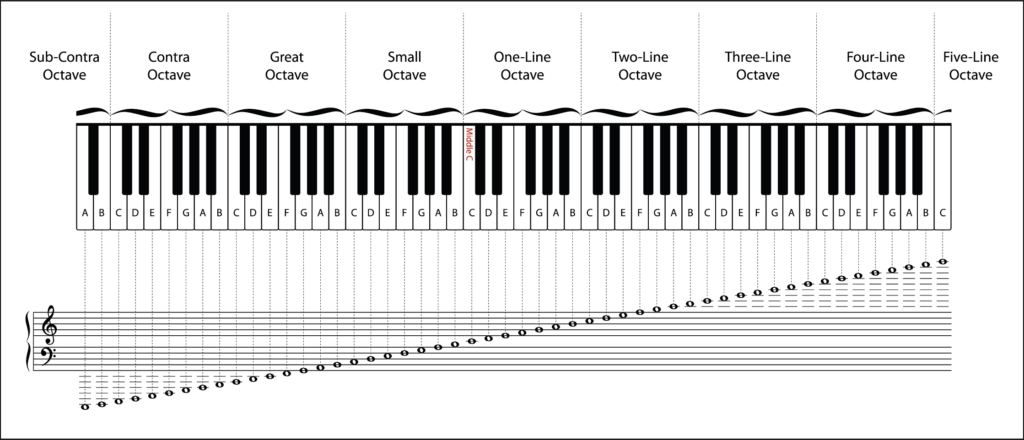
Note: The first C on the left of the piano is called C1. All notes up to the next C belong to the same octave number. So, the notes after C1 are D1, E1, F1, etc., until the next C, which is C2. Then the pattern continues: the notes after C2 are D2, E2, F2 and so on.
Is Knowing Your Voice Classification Important?
For classical and choral singers, voice classification plays a crucial role in selecting repertoire, auditioning for roles and protecting vocal health. Even for contemporary singers, understanding your vocal range and tone can be incredibly useful for:
- Choosing repertoire that suits your voice
- Adjusting song keys when necessary
- Preparing for auditions and stage productions
- Avoiding vocal strain and injury
How Do I Know What Voice Classification I Am?
While factors such as the health and condition of your voice may affect the accuracy of it, your voice classification is largely based on your current range and timbre (tonal colour). To determine your range:
- Sing your lowest comfortable note and write it down.
- Sing your highest comfortable note and write it down.
- Compare your range with the classifications above, keeping in mind that these are only general guidelines.
Additional Factors To Consider
- Is your voice currently healthy and functioning well?
- Does your voice have a naturally bright or dark tone?
- Do you feel more comfortable singing in a specific part of your range?
- Is your vocal tone naturally powerful and resonant, or is it lighter and more intimate?
Challenges With Voice Classification
While classification can be a helpful tool, it is important to avoid potential pitfalls:
- When was your voice classified? (Before or after vocal maturity?)
- Are you straining to fit into a classification? (Forcing high or low notes can be harmful.)
- Are you being restricted by labels? (Voice type should guide, not limit, your song choices.)
- Do you fear exploring different parts of your range? (Singing outside of your typical range isn’t necessarily harmful if done correctly.)
- Is knowing your classification necessary for your goals? (For contemporary singers, range and style may be more relevant than having a strict classification.)
Final Thoughts
Many singers are unaware of their full vocal potential simply because they have not explored it. Voice classification is a tool, not a limitation, that provides insight into your natural vocal tendencies but does not define your ability as a singer.
If you are uncertain about your classification or want to explore your voice safely, seek guidance from a qualified and experienced voice teacher. You may even discover new aspects of your voice along the way!