
In this article, we’ll explore how hearing works and why protecting it is crucial for singers, who rely on their ears for pitch accuracy, intonation and musical expression.
How Does Hearing Work?
Hearing begins when sound waves travel through a medium (air, water or solid) and reaches our ears. Different sound sources vibrate at different frequencies – high, medium, low or a combination (e.g. like in a rock band with drums, bass, guitar and vocals).
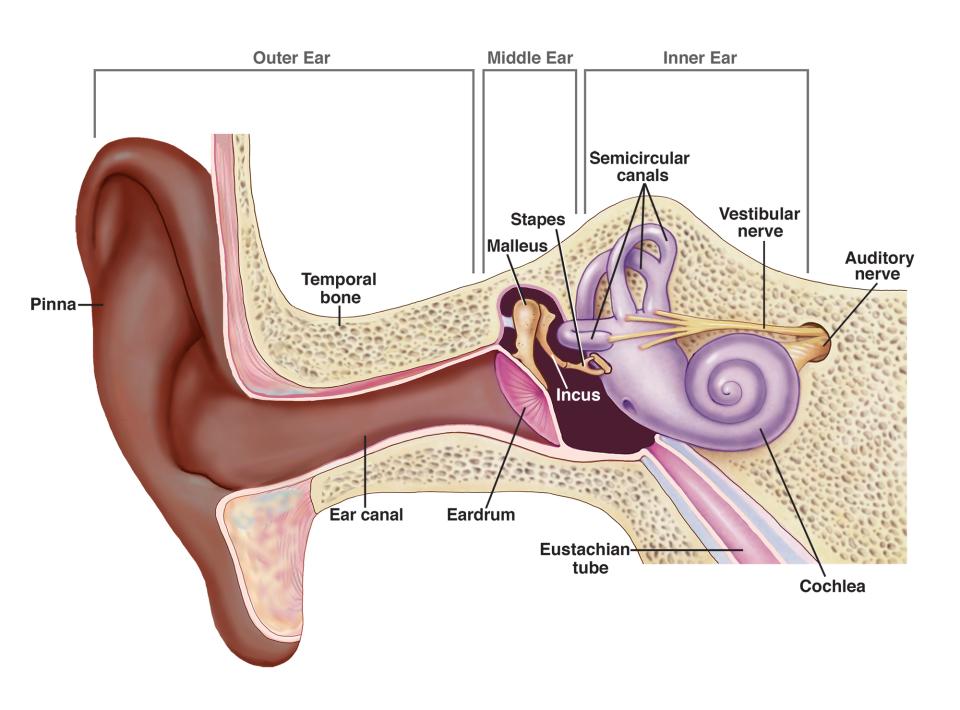
The outer ear captures these sound waves and funnels them to the eardrum, which vibrates in response. These vibrations pass through the three tiny bones of the middle ear and reach the snail-shaped cochlea in the inner ear. Fluid movement inside the cochlea stimulates specialised hair cells, which convert mechanical vibrations into electrical signals. These signals travel via the auditory nerve to the brain, where they are interpreted as sound. (See diagram below).
Frequency v.s. Pitch Range
Understanding the difference between frequency (the objective measurement of a sound wave) and pitch (the subjective perception of that frequency) allows singers to translate the science of sound into practical skills – matching notes accurately, tuning harmonies and adjusting their voice to what they hear rather than just what the instrument produces. This understanding plays a crucial role in:
- Matching notes accurately and tuning harmonies.
- Making precise vocal adjustments even when a note feels different.
- Detecting issues caused by ear fatigue or minor hearing loss.
- Enhancing musical expression through nuance, vibrato and tone colour.
Frequency
- Definition: The number of sound wave cycles (oscillations or vibrations) that occur in one second.
- Nature: A physical, objective property of a sound wave that can be measured with scientific instruments.
- Unit of Measurement: Hertz (Hz), meaning cycles per second.
- Example: A tuning fork vibrating at 440 Hz produces 440 cycles per second.
Pitch
- Definition: The subjective quality of a sound that determines how “high” or “low” it sounds to an individual.
- Nature: A perceptual phenomenon; the way the human ear and brain interpret the frequency of a sound wave.
- Measurement: Cannot be directly measured but is correlated with frequency.
- Example: The specific musical note or sound quality associated with a particular frequency. For example, the note A above middle C corresponds to 440 Hz.
The Hearing Range Of Humans
Humans typically hear frequencies between 20 and 20,000 Hz. Each species’ hearing range is adapted for survival, communication and environmental awareness. For humans, this range allows us to perceive music, speech and environmental sounds.
Why Singers Are More At Risk
Singers often rehearse and perform in environments where loud sound is unavoidable – from amplified band rehearsals to live stage monitoring. Unlike instrumentalists, singers rely entirely on auditory feedback to control pitch and resonance, meaning even subtle hearing fatigue can affect performance accuracy, vocal control and confidence.
Situations that present a higher risk for singers include:
- Extended rehearsals with amplified instruments
- Excessive volume levels in in-ear monitors
- Singing or performing close to drums or brass instruments
- Sudden feedback or high-frequency squeals on stage
Common Decibel Levels For Context
The loudness of sound is measured in decibels (dB). Prolonged exposure to high decibel levels can cause fatigue or damage. Here are some common examples for comparison:
- Normal conversation: approximately 60 – 70 dB
- Lawnmowers: 80 – 100 dB
- Rock concert: 100 – 120 dB
- Sirens: 110 – 130 dB
- Pain threshold: approximately 130 dB
- Fireworks: 140 – 160 dB
- Damage risk: prolonged exposure to sounds above 85 dB – the louder the sound, the shorter the safe exposure time.
Hearing Fatigue And Damage
Prolonged exposure to loud sounds can initially cause hearing fatigue, temporarily reducing sensitivity and affecting pitch perception. Repeated exposure may damage the cochlea’s hair cells, which do not regenerate, potentially leading to permanent hearing loss that may require hearing aids or surgical intervention.
Signs Of Ear Fatigue can include:
- Muffled or dulled hearing.
- Difficulty distinguishing pitches.
- Temporary ringing or buzzing (mild tinnitus).
- Reduced clarity of speech or music.
- Increased sensitivity to loud sounds.
- A sense of ear or mental fatigue.
Signs Of Early Damage can include:
- Needing to turn up the volume on headphones, speakers or devices.
- Difficulty hearing high frequencies (e.g. birdsong, cymbals, certain notes in music).
- Temporary ringing or buzzing in the ears after exposure to sound (tinnitus).
- Muffled or “dull” hearing that doesn’t immediately recover.
- Trouble understanding speech in noisy environments.
- Ear discomfort or pressure after exposure to loud sounds.
One common symptom of repeated noise exposure is tinnitus, which can affect both amateur and professional musicians.
Tinnitus
Tinnitus, or ringing in the ears, is common among singers and musicians. It may also be perceived as buzzing or other phantom sounds. Temporary tinnitus after loud music is usually caused by sensory cell fatigue and often resolves on its own. Persistent tinnitus however, may indicate hearing damage or other health conditions and medical advice should be sought.
When To Seek Professional Help
If you notice ongoing ringing, sensitivity to sound or difficulty hearing speech or music clearly, consult an audiologist or ENT specialist. Early intervention can help preserve hearing health and prevent long-term damage. Musicians can also request a musician’s hearing test, which assesses frequency-specific hearing loss and provides tailored protection advice.
Hearing Protection And Daily Habits
Protecting your ears depends on the situation – headphones, live music, concerts, noisy work environments, construction nearby, etc. Strategies include:
- Keep headphone volume ≤60% or lower whenever possible.
- Use noise-cancelling headphones instead of turning up volume to block background noise.
- Take short quiet breaks from loud sounds or every hour during rehearsal.
- Use musician’s earplugs for amplified settings.
- Avoid placing speakers or monitors directly at ear height.
- Position yourself strategically on stage – away from amps, loud instruments or behind barriers.
- Hydrate and rest – overall health supports auditory sensitivity.
- Take regular hearing tests to monitor hearing health.
Why This Matters For Singers
Hearing isn’t just about health – it is vital for pitch accuracy, intonation and vocal blend. Fatigued or damaged ears can directly affect your ability to sing in tune with expression. Protect your ears – they are your most valuable instrument, and unlike a guitar string or drum skin, they cannot be replaced. Taking steps to protect your ears today will preserve your musical expression for years to come.